Find what your requirements are missing before your developers do.
Specira AI puts five specialist agents on every requirement at once, grounds each one in the rules your organization already lives by, and hands you decisions you can trace instead of documents you have to trust.
 Click to expand
AI made developers 10× faster.
Nobody made the requirements better.
Coding tools got faster. Requirements didn't. They're still scribbled in Confluence pages nobody reads, split across a dozen Jira epics that contradict each other, full of gaps that nobody notices until QA. Ship faster from unclear specs and you just build the wrong thing faster. And here's the part that really stings: intent erodes at every handoff, from business vision to product spec to code.
Source: CISQ 2022
Source: Capers Jones
Source: NASA (Stecklein et al.)
Lost in Translation
A VP explains their vision over lunch. A Product Owner scribbles notes, interprets it on the train home, and writes a spec the next morning. A Business Analyst restructures that spec into user stories. A developer reads those stories three weeks later and builds what they think was meant. Sound familiar? We saw this exact chain at a $4 billion insurance company last year. Four handoffs, four interpretations, and a technically correct implementation of the wrong thing.
Months of Manual Work
Here's a number that should bother you: developers spend less than a third of their time writing code. Where does the rest go? Meetings where nobody takes notes. Slack threads asking "wait, did we mean this or that?" Cross-checking scattered documents across a dozen stakeholders who can't agree on what "done" looks like. One team we talked to in Montreal spent eleven weeks (we counted) just trying to align on a single feature's acceptance criteria.
Blind Spots Everywhere
Security gaps. UX blind spots nobody flagged because the UX person wasn't in the room. Technical feasibility questions the architect would have caught in five minutes (if anyone had asked). Adversarial scenarios that only surface during pen testing. No single person covers every angle, and honestly? These get missed on almost every project we've seen. By the time someone notices, you're deep in sprint 8 and the fix costs 10 times what prevention would have.
No Traceability
Decisions get buried in email threads from six months ago, in a meeting recording nobody will ever re-watch, in the head of that one person who just left the company. When auditors show up (or worse, when a new team member asks "why did we build it this way?"), the room goes quiet. Nobody has a clear answer because nobody wrote one down.
The Agentic Requirement
Intelligence Platform
Forget document-first requirements. (Honestly, those 80-page specs were always more fiction than blueprint anyway.) Specira works decision-first, through a Decision Intelligence Layer where five specialist AI agents turn raw input into validated decisions. Four of them (business, UX, architecture, and security) analyze every input at the same time. A fifth, a Red Team Critic, challenges what they find before any document exists. Gaps surface early, not three sprints later when someone finally reads the fine print.
From intent to execution:
nothing lost in translation.
Business leaders talk outcomes. Product owners talk features. Developers talk systems. They're all describing the same thing and somehow meaning something completely different. We've sat in those rooms. We know how it feels when a three-hour workshop ends and everyone walks away with a different understanding of what just got decided. Specira bridges those gaps. Its specialist AI agents guide the conversation together, translating what stakeholders actually mean into specifications precise enough to build from. Every perspective covered. Every decision traceable.
From Idea to Actionable Spec
AI-driven interviews turn rough business ideas into structured requirements. Business logic, edge cases, acceptance criteria: the stuff that usually takes weeks of back-and-forth between six people who can never find a meeting slot. Covered in a fraction of the time.
Four Analyst Perspectives, One Critic
Remember the telephone game from school? Enterprise requirements work the same way, except the stakes are millions of dollars and nobody's laughing. Four of Specira's five specialist AI agents examine every requirement at once: Business Analyst, UX Researcher, Solutions Architect, and Security Analyst. Translation happens once, with every perspective in the room. No more "I thought you meant the other thing."
Decision-Attributed Traceability
Every decision, every rationale, every stakeholder input: tracked, versioned, and audit-ready. Six months from now, when someone asks "why did we choose this approach?", the answer is two clicks away. Not buried in someone's email archive.
Quality Gates Before Output
A Red Team Critic agent plays devil's advocate on every recommendation before it reaches your team. Think of it as the person in the room who isn't afraid to say "have we actually thought about what happens when this breaks?" Gaps get caught before code is written, not after.
How does Specira turn a conversation into requirements?
Most tools generate documents. (We've all seen those AI-generated specs that sound impressive until you try to actually build from them.) Specira translates intent into decisions. Here's what that looks like in practice: a vague idea goes in, structured and validated requirements come out.
Any input, not a blank form
A discovery conversation, the charter from the AI Project Planner, documents and spreadsheets, screen recordings with narration, and the web sources the agents fetch themselves.
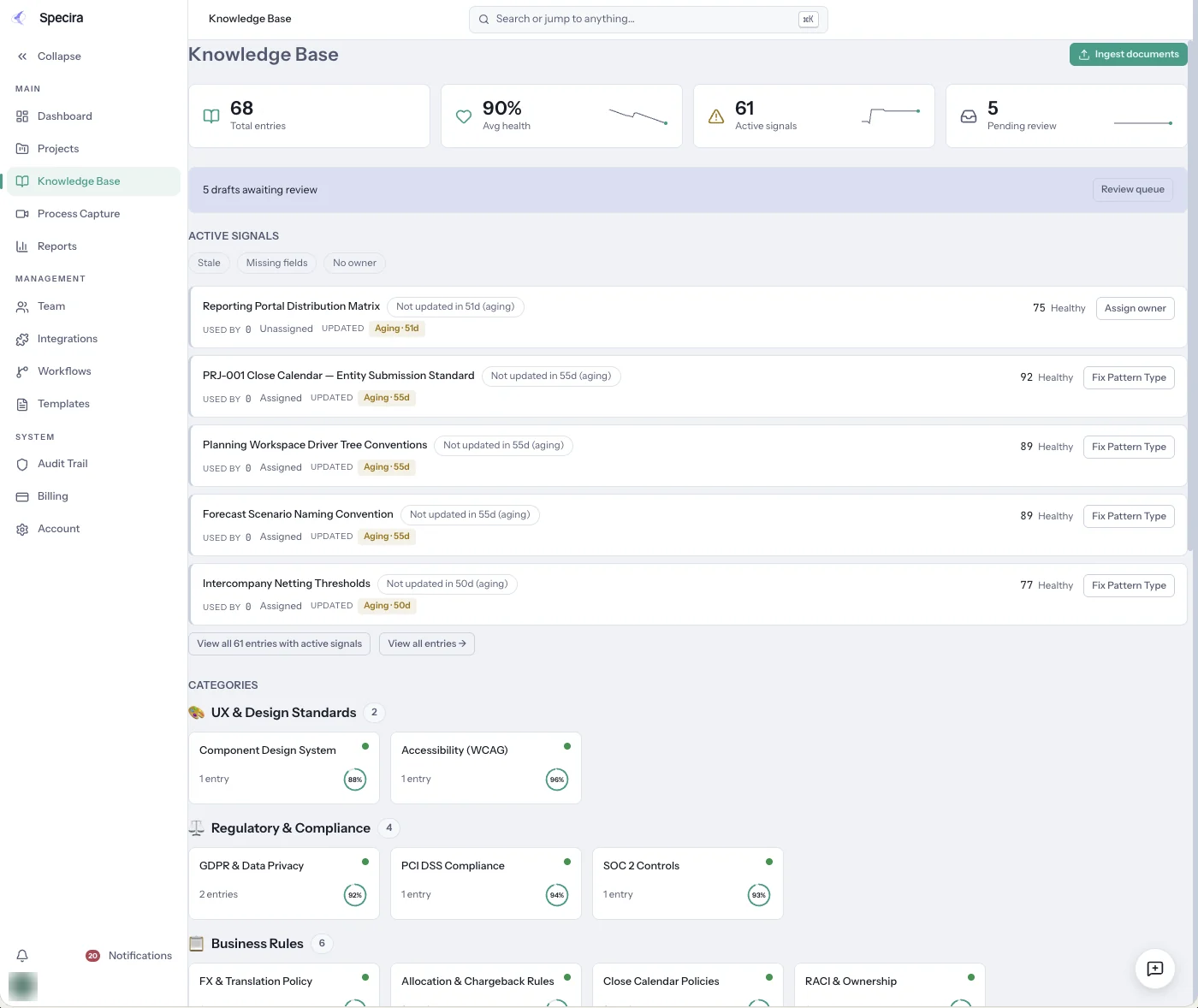
Grounded in your knowledge base
Before any agent speaks, it pulls the knowledge its discipline needs: the analyst reads business rules and key performance indicators (KPIs), the architect reads integration contracts and architecture decisions, security reads regulatory obligations. Each match carries evidence and a confidence score. Contradictions get flagged.
One leads. Four weigh in, inline.
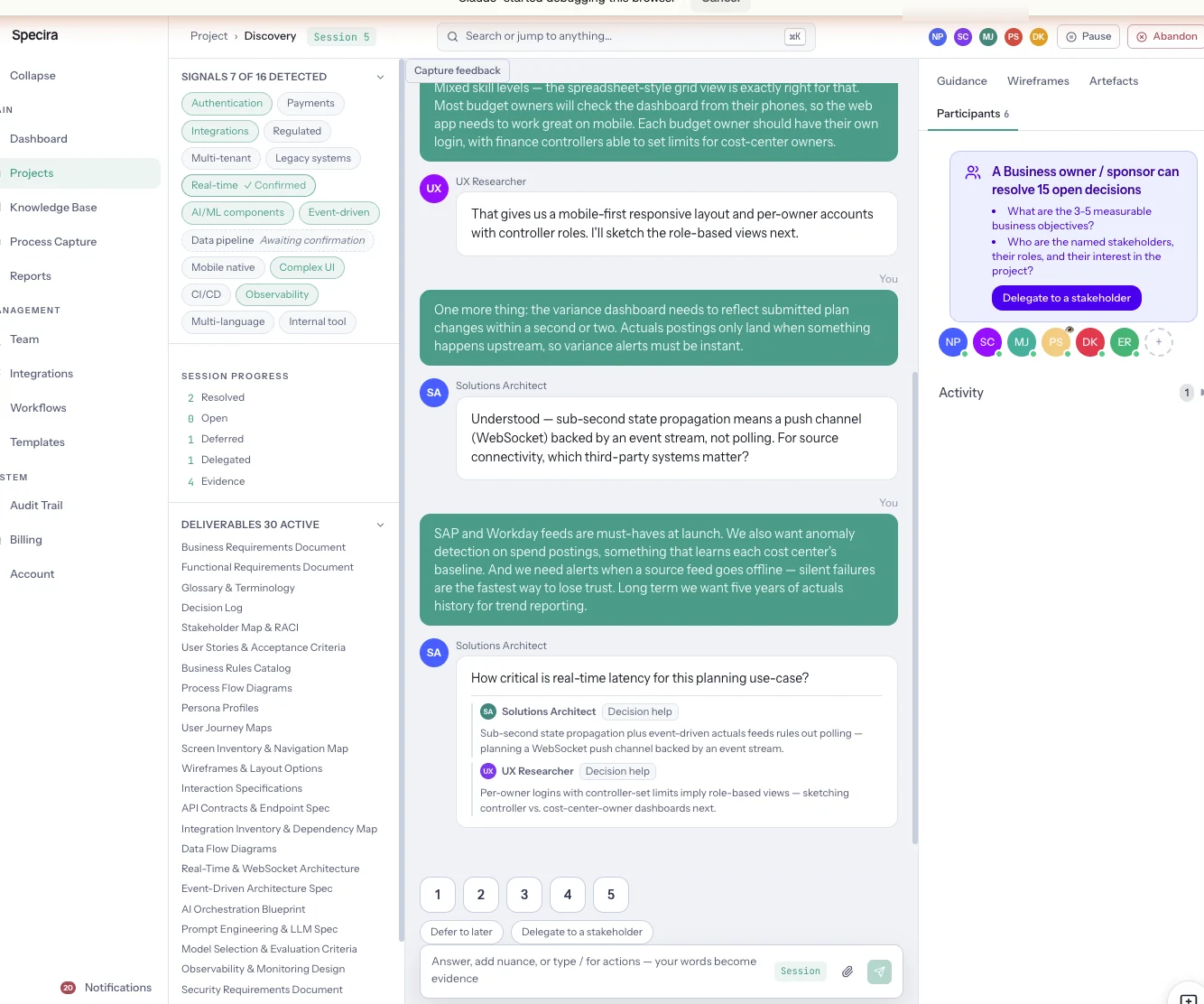
In Specira, one specialist runs the conversation and asks what its discipline needs. The other four read the same turn at once and add a note the moment they have one: a risk, a constraint, a contradiction, a scope alert.
What should the client see while a document is pending approval?
Attributed, gated, exportable
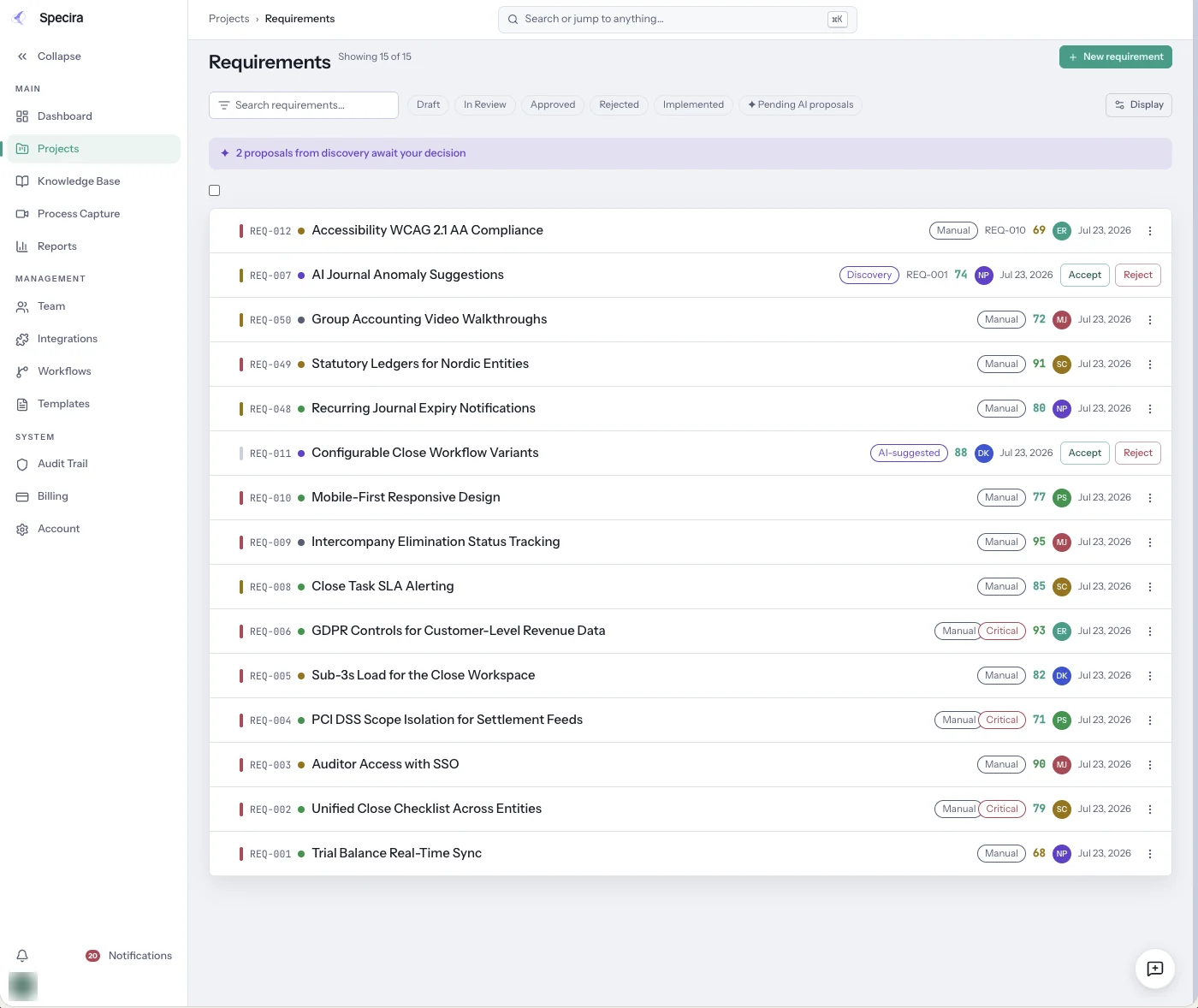
Signals detected in the conversation activate the right deliverables. Export opens once the decisions are resolved (deferred ones ship listed in the gap report), and every field carries who decided, when, from what evidence.
Red Team Critic: always on, never a phase
Present on every turn whether or not anyone asks for it. It stress-tests each answer for contradictions, missing exceptions, abuse cases and evidence gaps, guards the scope you agreed to in the charter, and runs the export readiness check. Each finding names a next step.
What each analysis agent brings to the table
What it catches
- Missing revenue model or monetization strategy
- Undefined user segments and personas
- No success metrics or acceptance criteria
- Business rules with conflicting logic
Example
"I need a client portal with document sharing"
12 structured decisions covering user roles, permission levels, document lifecycle, notification rules, and SLA requirements.
What it catches
- Missing error states and empty-state designs
- Accessibility gaps (screen readers, keyboard navigation)
- Unclear onboarding and first-use experience
- Edge-case user flows nobody considered
Example
"Users should be able to upload and share documents"
Flags 8 missing flows: bulk upload, drag-and-drop, file type restrictions, progress indicators, failed upload recovery, mobile upload experience, shared link expiry UX, and offline access handling.
What it catches
- Scalability bottlenecks and performance risks
- Integration conflicts with existing systems
- Technical debt from architectural shortcuts
- Missing non-functional requirements (latency, throughput)
Example
"The portal needs approval workflows"
Identifies need for async processing, defines state machine for approval statuses, flags potential deadlock in multi-level approvals, and specifies API contract for integration with existing ERP.
What it catches
- Data residency and sovereignty violations
- Missing encryption requirements (at rest, in transit)
- Audit trail gaps for regulated industries
- Non-compliance with GDPR, HIPAA, SOC 2 frameworks
Example
"Clients can share documents with external partners"
Requires data classification policy, external sharing audit log, automatic link expiry, watermarking for sensitive documents, and DLP scanning before external transmission.
What it catches
- Optimistic assumptions the four analysts agreed on too fast
- Edge cases and failure modes nobody stress-tested
- Conflicts between agent outputs that look fine in isolation
- Requirements that pass review but break under real load
Example
"The four analysts signed off on the approval workflow"
Surfaces 5 failure modes the others missed: duplicate approvals from a double-click, an orphaned request when an approver leaves mid-cycle, a race condition when two managers act at once, no timeout path for a stalled step, and a silent mismatch when the ERP rejects the final write.
Every stakeholder answers on their own clock.
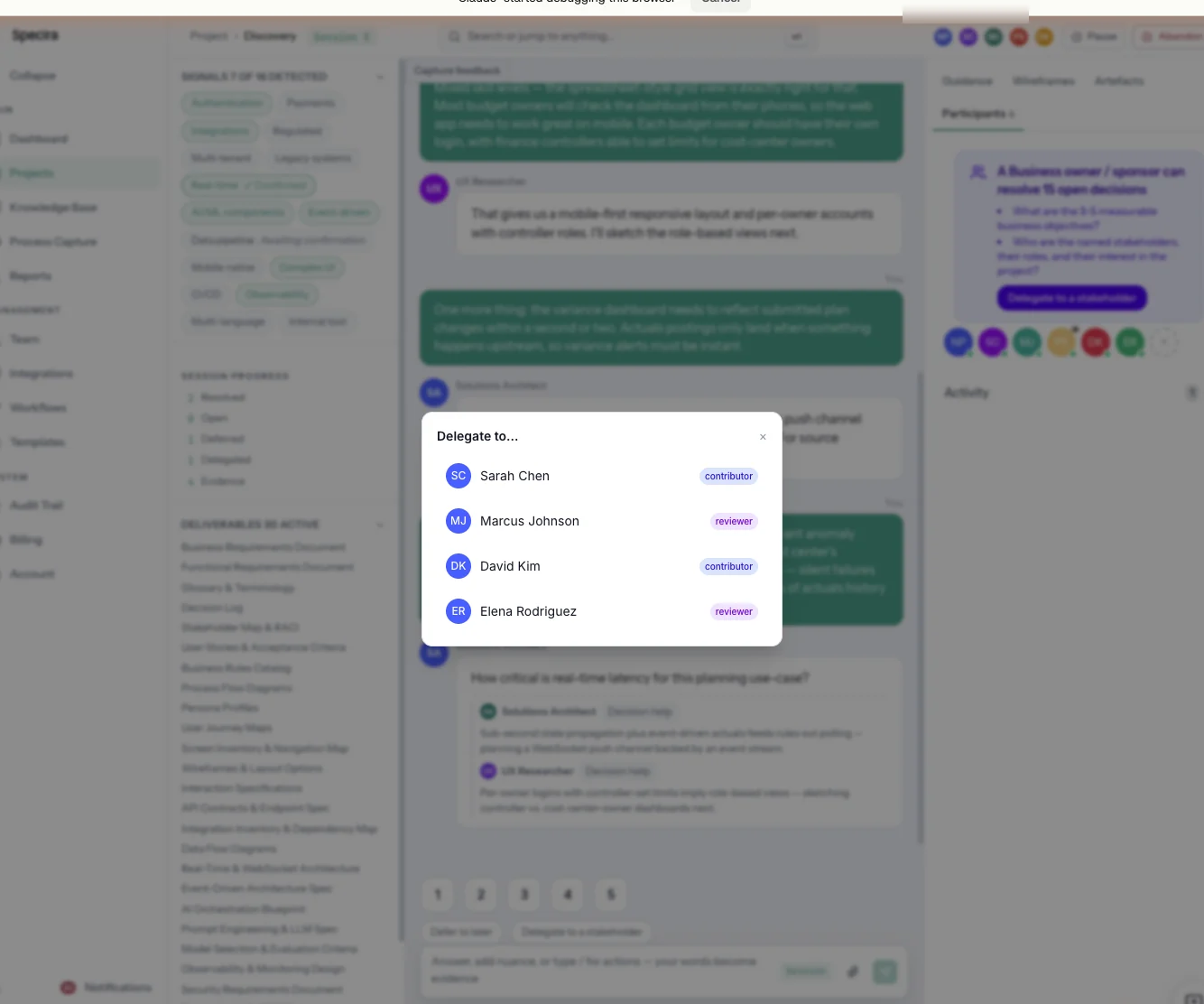
Distributed team, five time zones, one finance controller who is free on Thursdays. Specira does not wait for the meeting. A question that needs Sarah goes to Sarah, with a link straight back into the session, and the work keeps moving around it.
- 📤Delegate a question, not a meeting.Any open question goes to a named participant. They get an in-app alert and an email link into the session, and answer when they can.
- 📋Nothing waits unseen in an inbox.Every delegation shows on that person's dashboard under Waiting on you, across all their sessions, and turns red once overdue.
- ⏲Defer without losing the thread.Deferring parks the step, records who deferred it and why, and carries the gap into the export report instead of dropping it.
- 👥See who is in the room.Presence avatars and typing indicators for whoever is on right now. Invite a stakeholder by email with a single-use link that expires in seven days.
- ✅Sign-off by stage.Approval workflows follow a RACI grid (responsible, accountable, consulted, informed); each request lands with one named approver.
The alignment meeting becomes the exception, not the schedule.
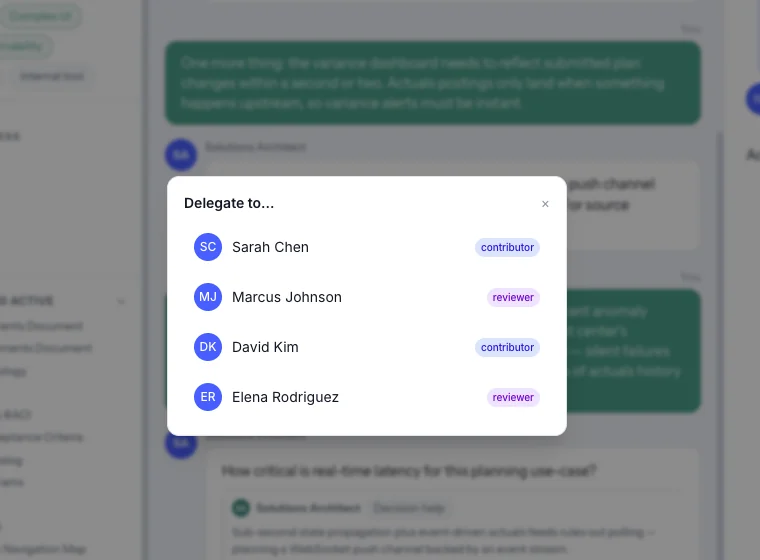
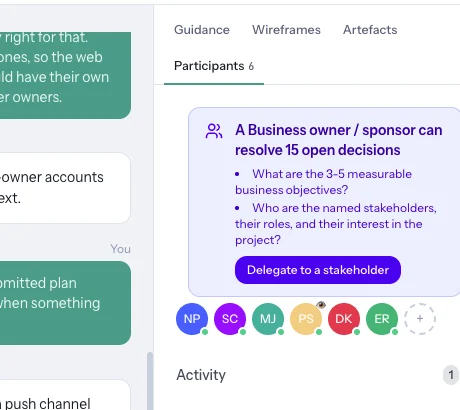
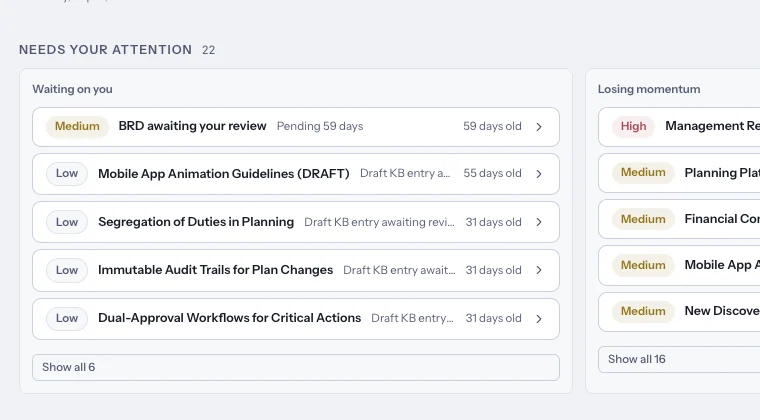
Solutions Architect asks: which third-party systems must connect at launch?
You delegate to Sarah Chen. In-app alert and email link sent. The session continues on other questions.
Sarah answers from the link, on her time. The delegation closes and the parked step resumes.
Red Team Critic reads her answer on the next turn, like every turn.
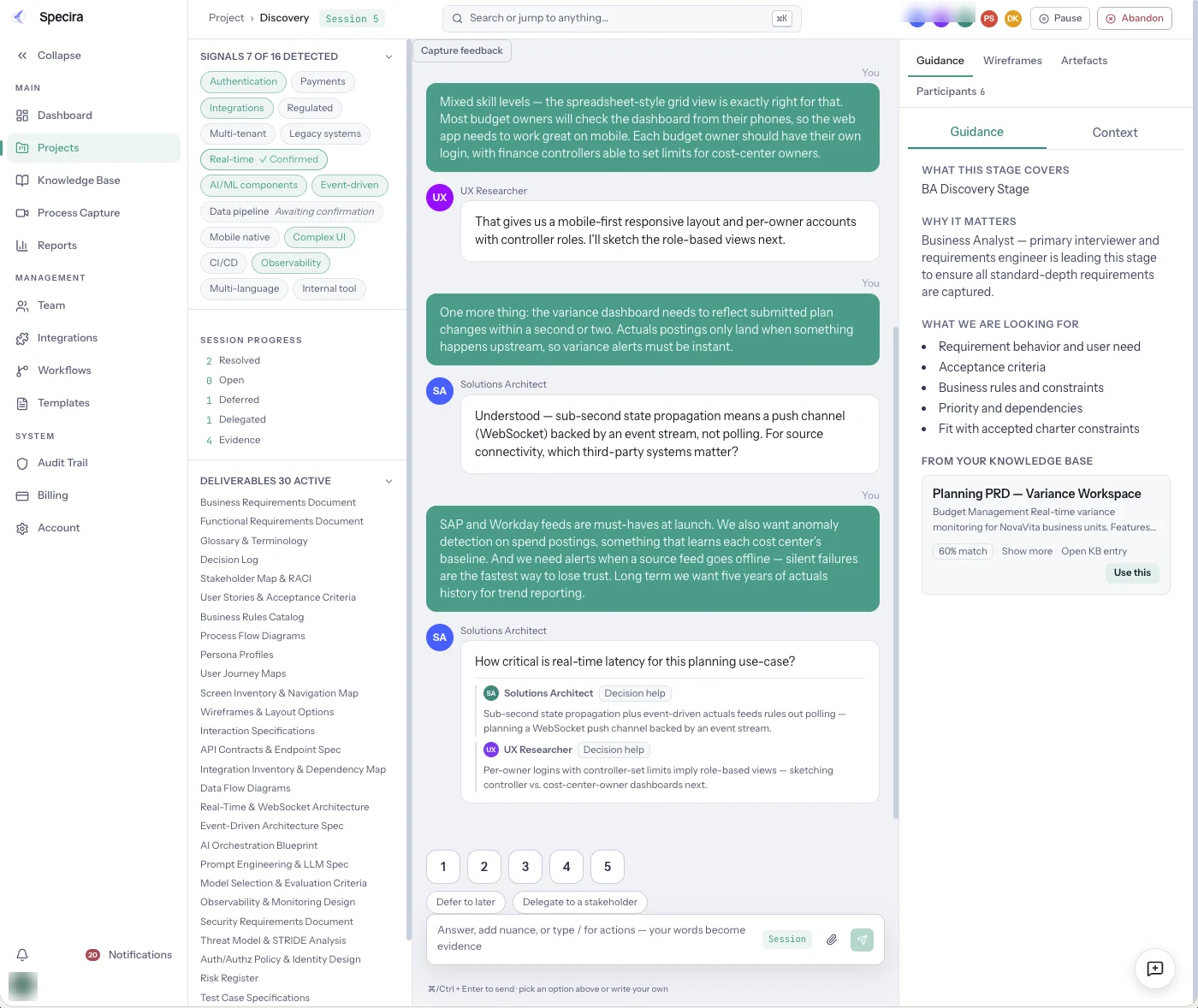
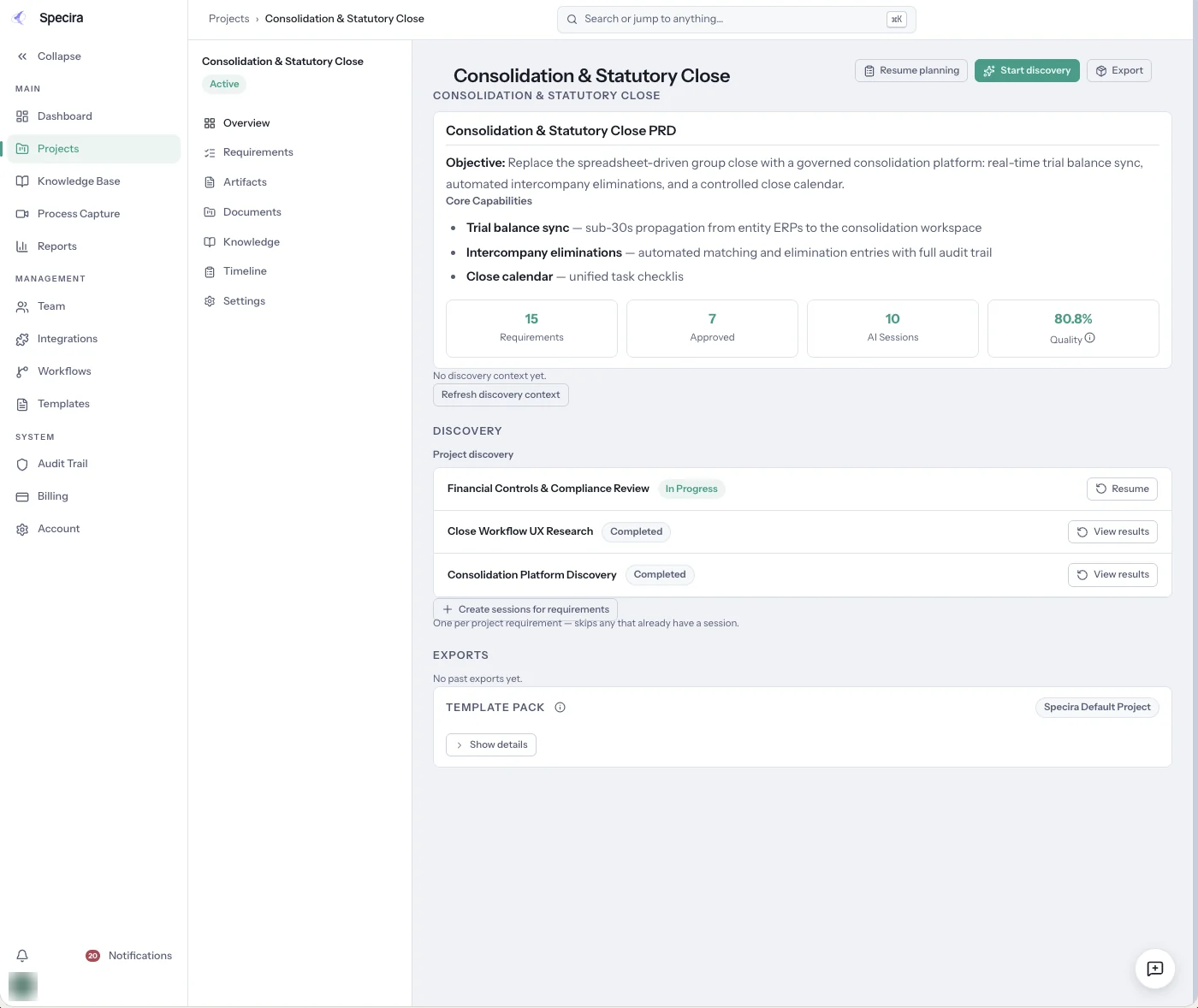
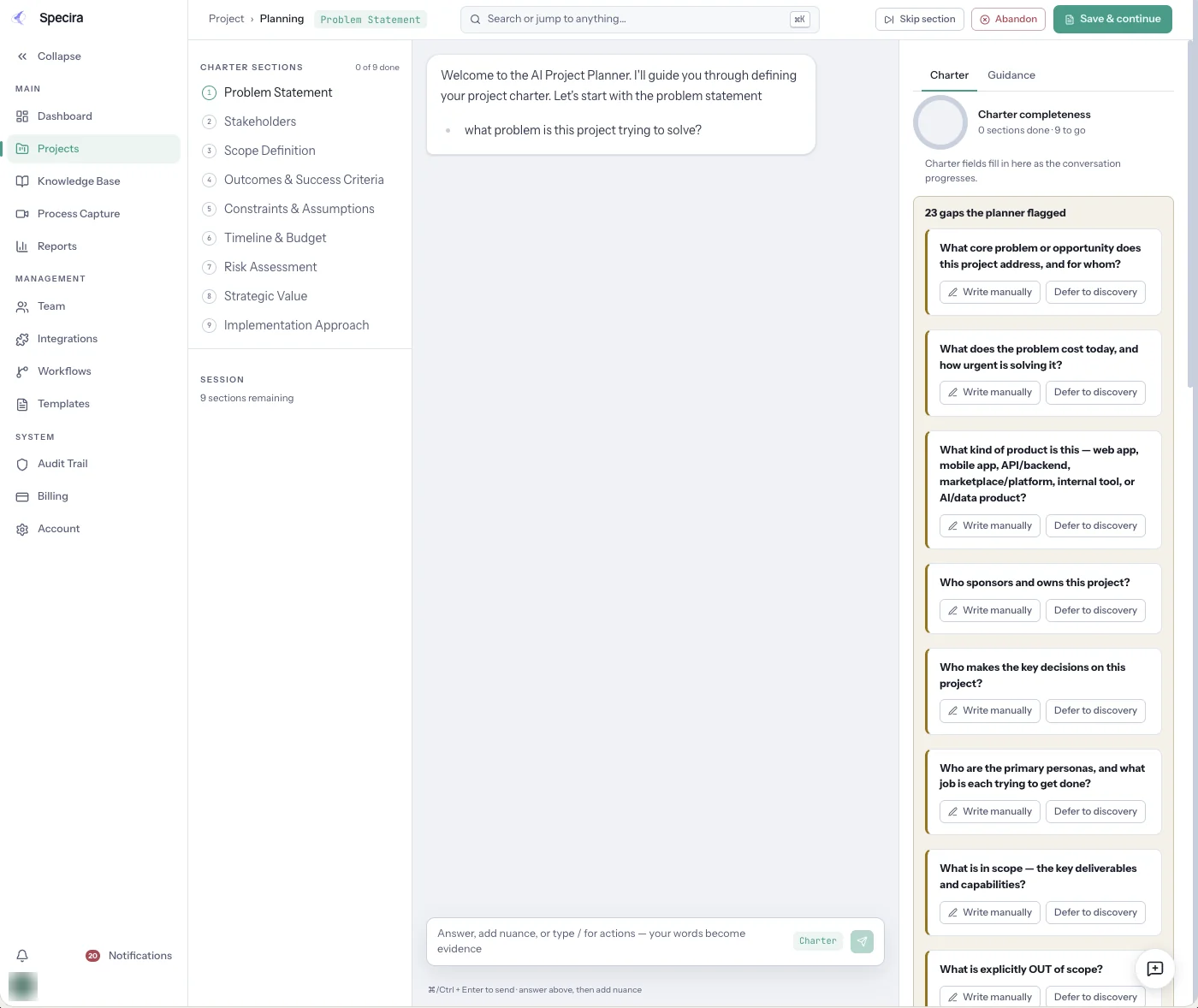
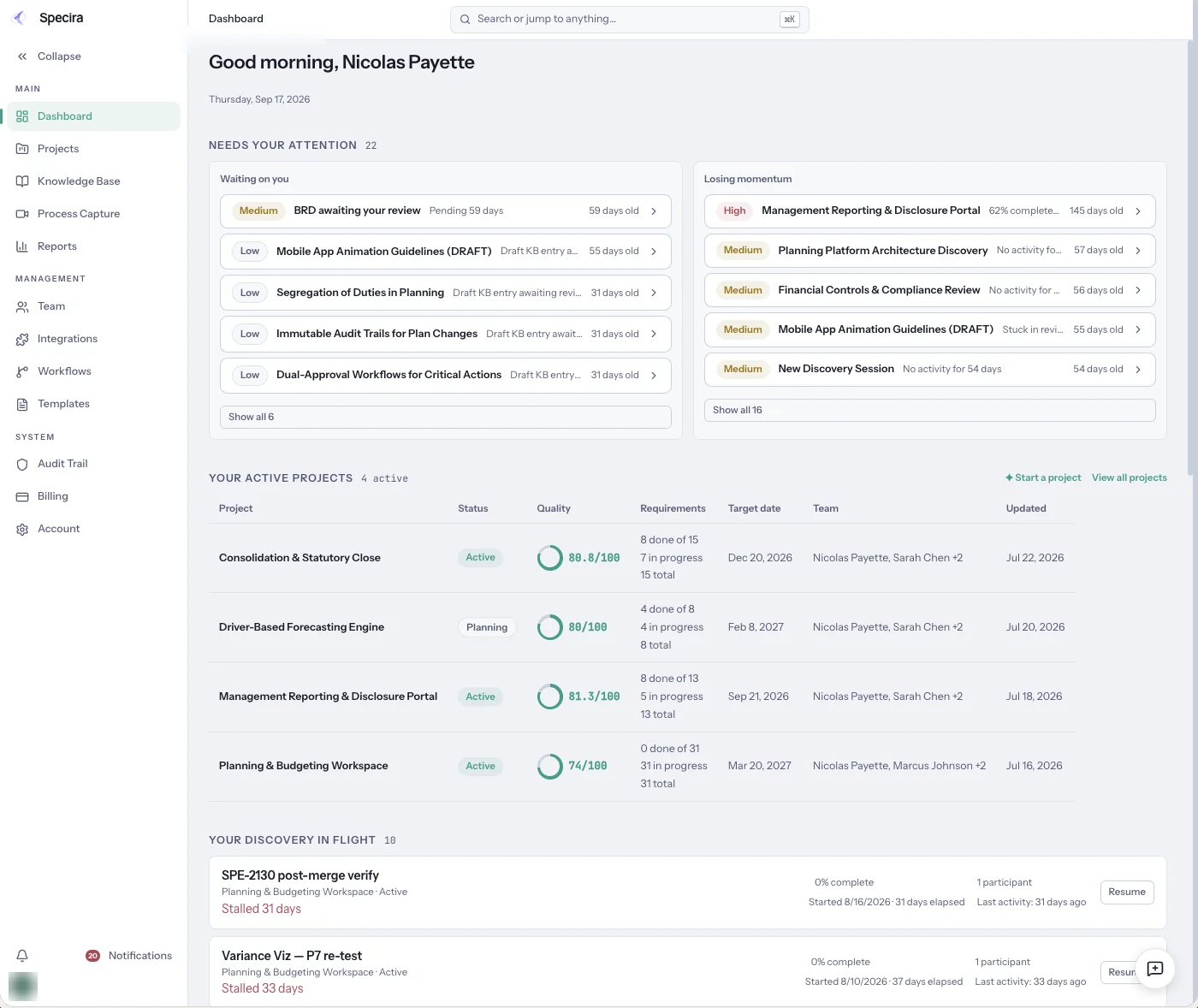
What your team sees, screen by screen.
Real screens from a seeded Specira demo workspace; the counts and scores are sample data. Click any one to expand it.
Common questions about Specira.
Quick answers for teams evaluating whether Specira fits their initiative. Need more detail? Visit the full FAQ page.
Be among the first to experience Specira.
We run demos with a small group of enterprise teams each month. If you're in the middle of a major transformation (or dreading the next one), we'd genuinely like to hear what you're dealing with.
Thank you!
We've received your request. Our team will reach out shortly to discuss how Specira can help your organization.